ADVERTORIAL

WARNING: That Cheap "Titanium" Pan You Saw Online Might Not Be Titanium At All — And Some Experts Fear Families Are Cooking On Unknown Coatings Every Day

November 23rd, 2026 | Consumer Product Safety Review
For nearly two decades, I investigated counterfeit household products and material safety violations across the U.S. I’ve tested everything from fake supplements to contaminated children’s products. But I never expected cookware to become one of the fastest-growing counterfeit categories online — until my own sister unknowingly bought a fake “titanium” pan that completely changed the way I look at modern cookware.

I worked in consumer product safety and manufacturing compliance for 18 years. My job was to investigate imported goods, identify counterfeit materials, and determine whether products actually matched the safety claims printed on their packaging.
Over the years, I saw counterfeit electronics overheat and fail. I saw imitation water filters made with unverified plastics. I even investigated cookware manufacturers using misleading material claims to market cheap products as “premium.”
But I never paid much attention to the titanium cookware trend until my sister called me one evening asking a simple question.
She had recently ordered a “Titanium Frying Pan” after seeing an online advertisement claiming it was “chemical-free,” “medical-grade,” and “healthier than traditional nonstick cookware.” The photos looked convincing. The reviews looked real. And at under $60, she thought she had found an incredible deal.
When the pan arrived, something immediately felt wrong.
The surface looked uneven under direct light. The underside began discoloring after only a few uses. Most concerning of all, the pan released a strange metallic odor whenever heated at high temperatures.
At first, she assumed it simply needed seasoning or “breaking in.” But when eggs started sticking badly after less than two weeks, she asked me to take a closer look.
What I discovered immediately raised concerns.
The Investigation That Shocked Me
I brought the pan back to my workshop and began running the same material inspections I used throughout my career.
Under magnification, the “titanium surface” already showed microscopic surface separation around the edges. The cooking layer appeared to be an ultra-thin metallic coating bonded onto ordinary stainless steel underneath.

There was no certification paperwork.
No titanium purity documentation.
No manufacturer traceability.
No indication the pan was actually constructed from pure titanium at all.
The word “Titanium” had simply been printed across the packaging.
Unfortunately, this is becoming increasingly common.
As titanium cookware exploded in popularity online, counterfeit manufacturers moved quickly. Today, many products sold as “titanium pans” are actually ordinary steel or aluminum cookware covered with titanium-colored coatings designed to imitate the appearance of genuine titanium.
To the average customer, they look nearly identical in photos.
But once repeatedly exposed to cooking heat, many begin degrading rapidly.
That’s where the entire problem begins.
Why Fake “Titanium” Pans Could Be A Serious Problem
Most families switching to titanium cookware are trying to move away from traditional coated nonstick pans. They want fewer coatings touching their food. Fewer chemicals exposed to heat. Fewer concerns about scratched or peeling cooking surfaces over time.
But many counterfeit “titanium” pans simply replace one questionable coating with another.
The difference is consumers often don’t realize it.
Several imitation pans I tested released strong burnt odors after repeated preheating. Others developed discoloration around the cooking surface after only weeks of use. One sample began flaking near the edges after ordinary scrubbing and high-heat cooking.
And once coatings begin degrading under repeated heat exposure, microscopic particles and chemical residues may gradually enter food during everyday cooking.
That’s exactly what concerned me most.
Because most counterfeit manufacturers never disclose what those surface coatings are actually made from.

Some appear to use low-cost metallic sprays.
Others rely on layered industrial coatings designed to imitate titanium visually while costing a fraction of the price.
Consumers assume they’re buying clean, coating-free cookware.
But in reality, many may still be cooking on chemically treated surfaces exposed to daily high heat.
Ironically, families trying to avoid concerns associated with traditional nonstick cookware may unknowingly end up right back where they started.
That’s what makes fake titanium cookware so deceptive.
The entire reason people buy titanium cookware is for peace of mind.
But if the pan isn’t actually pure titanium, that peace of mind may be completely false.
The Search For A Genuine Titanium Pan

After testing dozens of products online, I began researching companies that specialized in actual pure titanium cookware rather than coated imitations.
That search eventually led me to the Esslyn Titanium Pure Pan.
At first, I was skeptical. Every brand online seemed to claim they used “premium titanium.” But once I reviewed Esslyn’s manufacturing specifications, the difference became obvious immediately.
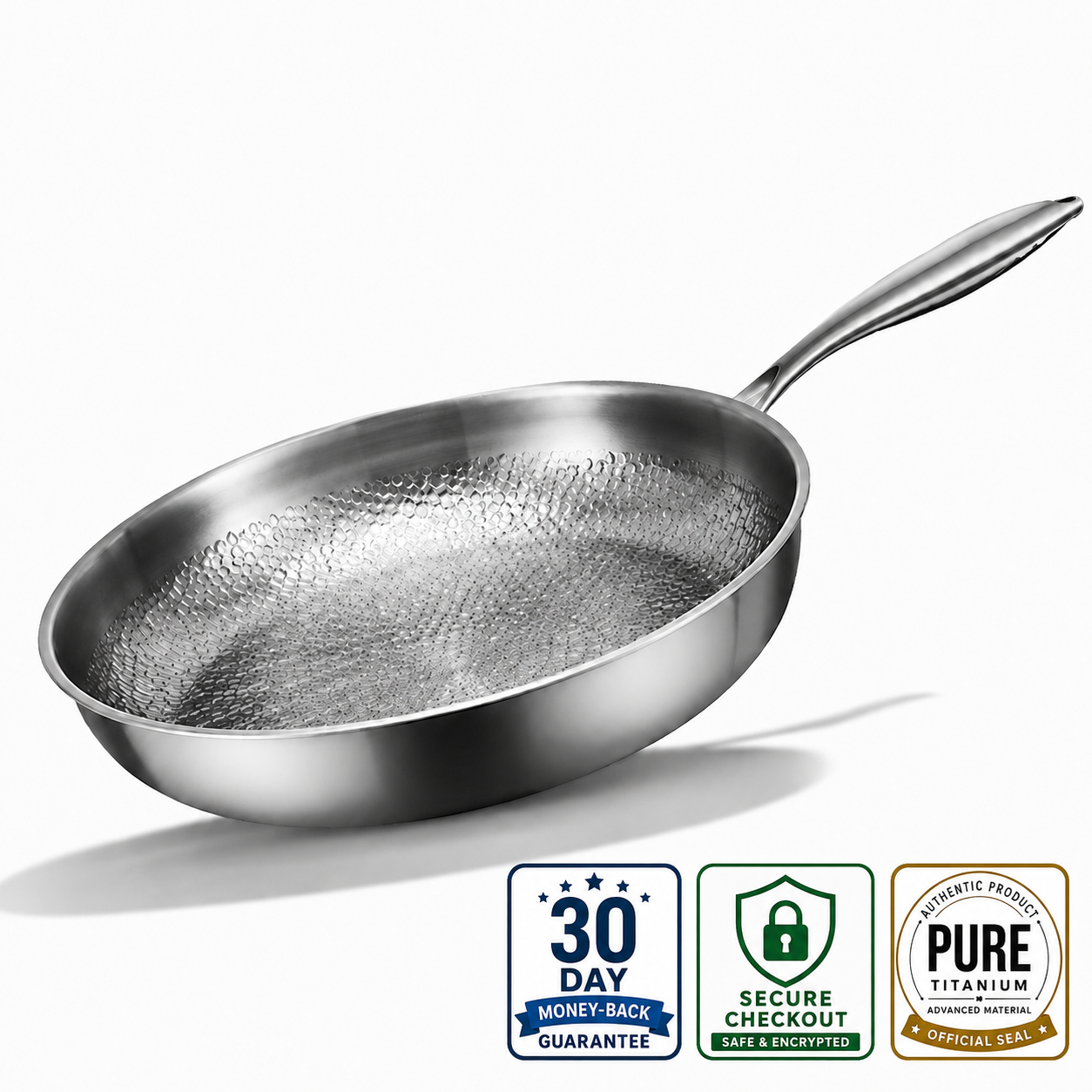
The Esslyn Titanium Pure Pan is crafted from 99.8% pure titanium with full Pure Titanium Certification directly from the manufacturer.
No sprayed coating.
No layered chemical surface.
No hidden nonstick treatment.
Just pure titanium engineered into the pan itself.
That distinction matters far more than most people realize.
How To Identify Genuine Titanium Cookware

After years spent investigating counterfeit consumer products, I’ve learned that misleading marketing almost always follows the same pattern. Companies use vague wording, attractive photos, and low pricing to imitate premium products while avoiding precise material disclosures.
That’s why consumers need to know what to look for before buying titanium cookware.
1. Look For Actual Titanium Purity Disclosure
Many fake products avoid using phrases like “pure titanium” entirely. Instead, they rely on vague marketing language such as:
•“Titanium technology”
•“Titanium-infused”
•“Titanium-style coating”
•“Titanium surface”
Those phrases often reveal very little about the actual cooking material.
Esslyn clearly states the Titanium Pure Pan is made from 99.8% pure titanium and includes certification verification.
2. Be Cautious Of Unusually Cheap Pricing
Titanium is one of the most expensive cookware materials available because of its durability, corrosion resistance, and biocompatibility. It’s widely used in aerospace engineering and medical implants for precisely those reasons.
Real titanium cookware cannot be mass-produced cheaply without major compromises somewhere in the manufacturing process.
If a “pure titanium pan” sells for extremely low pricing online, consumers should ask serious questions.
3. Pay Close Attention To Where The Product Is Sold
Many counterfeit cookware sellers constantly disappear and relaunch under new marketplace listings every few weeks. Branding changes. Store names change. Reviews disappear. Yet the same imitation products continue circulating online.
Esslyn officially confirmed they only sell directly through their official website in order to maintain product authenticity and quality control.
The Difference I Personally Noticed With Esslyn
After weeks of testing questionable products, I ordered the actual Esslyn Titanium Pure Pan directly from the company.
The difference was noticeable immediately.
The pan felt lighter than traditional stainless steel cookware, yet remarkably solid. There was no artificial glossy coating feel. No chemical odor during heating. No signs of layered surface treatments.
More importantly, the material behaved completely differently during heat testing.

I ran repeated high-temperature cycles, aggressive scrubbing simulations, and metal utensil resistance tests. The surface remained stable throughout.
No peeling.
No coating separation.
No flaking.
That’s because there is no synthetic nonstick coating to begin with.
Instead, Esslyn engineers use a precision-forged micro-texture directly formed into the titanium surface itself. The structure is inspired by the lotus leaf effect found in nature, allowing food to release more smoothly without relying on traditional chemical coatings.
I’ll admit I was skeptical at first.
Then I cooked with it myself.

Eggs released cleanly with minimal oil. Cleanup took seconds. And unlike coated cookware, I never worried about scratching through a hidden chemical layer underneath.
Why More Families Are Switching

Most people buying titanium cookware are not professional chefs.
They’re ordinary families who are simply tired of replacing peeling nonstick pans every year. They want cookware that feels cleaner, more durable, and easier to trust long term.
And honestly, I understand why.
Your cookware touches nearly every meal your family eats.
Every breakfast.
Every dinner.
Every meal prepared for your children.
That’s why material transparency matters so much.
What Real Customers Are Saying


Why I’m Sharing This Now
Counterfeit products are no longer limited to luxury handbags or electronics. They now exist in products families use every single day inside their kitchens.
That’s why real materials matter.
That’s why transparency matters.
And that’s why consumers deserve to know exactly what they’re buying.
The good news is genuine titanium cookware does exist. Consumers simply need to know how to distinguish authentic products from the growing flood of imitations online.
How To Get The Genuine Esslyn Titanium Pure Pan

As titanium cookware continues trending online, counterfeit listings have become increasingly common across third-party marketplaces. Esslyn warns consumers to be cautious of imitation products using misleading “Titanium” marketing language and unauthorized product imagery.
The genuine Esslyn Titanium Pure Pan is currently available exclusively through the company’s official website.
Every order includes:
✓ Pure Titanium Certification
✓ 30-Day Money-Back Guarantee
✓ Fast U.S. Shipping
✓ Compatible With Gas, Electric & Induction Stoves
✓ No Chemical Coatings
✓ Built For 10–20+ Years Of Daily Use
Esslyn is currently running a limited U.S. launch promotion reducing the price from $299 to $149.99 while inventory remains available.
Because when it comes to cookware your family uses every day, “looks similar” simply isn’t good enough.
🔥 Inventory Notice: Due to rising demand and increasing awareness surrounding counterfeit cookware products, several recent batches sold out completely. Current inventory allocation is limited while the next production run is finalized.
References
¹ Per- and Polyfluoroalkyl Substances (PFAS) and Your Health. Agency for Toxic Substances and Disease Registry (ATSDR). https://www.atsdr.cdc.gov/pfas/index.html
² Food Packaging and Cookware Chemicals of Concern. Environmental Working Group (EWG). https://www.ewg.org/what-are-pfas-chemicals
³ Titanium biocompatibility. https://en.wikipedia.org/wiki/Titanium_biocompatibility
⁴ Lotus Effect. https://www.sciencedirect.com/topics/engineering/lotus-effect